



Key takeaways:
- AI literacy = the ability to understand, use, assess, and oversee AI in a professional context; there is no need to be a technical expert, but you must be able to recognize the limitations and errors of a system.
- Article 4 of the AI Act requires providers and deployers to develop the AI literacy of their staff (and external service providers), without a standardized examination; the expected level depends on the role and the risk.
- Key challenges in 2026: fines of up to €35 million or 7% of global turnover, enhanced credibility when accessing European funding, and reduced internal grey areas.
- Training must be differentiated according to profiles: management (risks and priorities), managers (authorized uses), end users (verification of results), legal/HR/IT functions (targeted modules).
- Best practices: register of systems used, defined authorized tools, escalation procedure in case of doubt, records of training retained.
- AI literacy must be integrated into overall governance and evolve with usage; a fixed policy quickly loses its relevance.
Artificial intelligence is no longer reserved for technical teams. It is now part of writing, analysis, recruitment, customer relations and management tools. As a result, companies must now know who is using what, in which context and with what level of control.
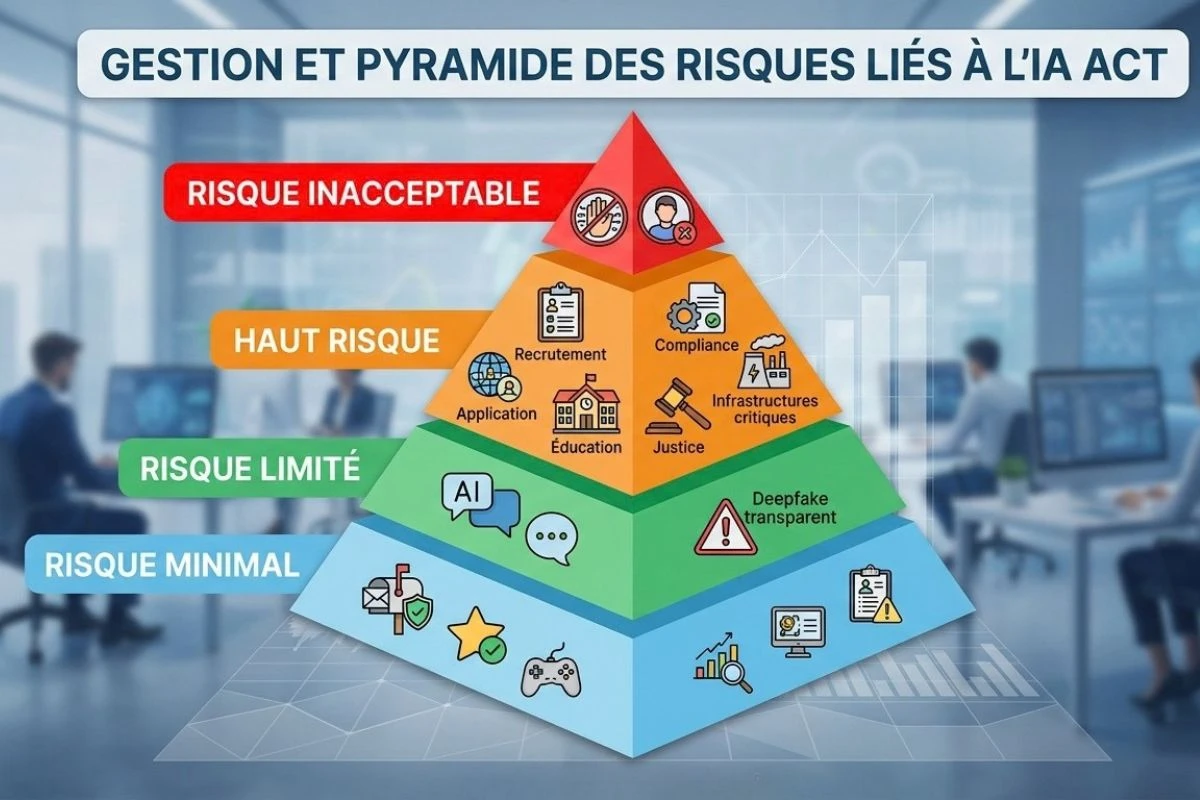
This is precisely what AI literacy is about, or AI literacy. In 2026, this skill takes on a very concrete dimension with the entry into application of new obligations related to the AI Act, particularly for high-risk systems. For SMEs and mid-sized companies, the question is therefore no longer simply about training teams to use AI more effectively, but about giving them enough perspective to understand its limitations, avoid errors and document the decisions that result from it.
What is AI literacy and why has it become essential?
Definition of AI literacy: beyond simple technical understanding
AI literacy refers to the ability to understand, use, evaluate and oversee artificial intelligence systems in a professional context.
This is not about turning every employee into a machine learning specialist. However, everyone should be able to understand a few basic concepts.
- Where does the data come from?
- What can a model actually do?
- Why can a generated response be incorrect?
- How can you distinguish content produced by AI from verified information?
The skill becomes especially useful when it translates into everyday practices. Knowing how to write a prompt is not enough. You also need to know what information should never be shared with a tool, how to verify an output, when to request human validation and in which situations the use of AI should be avoided.

Key AI literacy skills for organizations
Within a company, AI literacy becomes truly useful when it aligns with actual uses. The needs of an HR manager, lawyer, sales representative or analyst are not the same.
- Understand the general functioning of an AI system, its purpose, its data and its limitations.
- Use only authorized tools, without transmitting sensitive or confidential information.
- Evaluate a response before incorporating it into a document, analysis or decision.
- Escalate a concern to the appropriate person when a result affects a customer, an employee or a sensitive decision.
AI literacy and the European regulatory framework: what the AI Act changes in 2026
Article 4 of the loi européenne sur l’intelligence artificielle requires providers and deployers of AI systems to take measures to develop the AI literacy of their staff and of people acting on their behalf.
The text sets neither a mandatory examination nor a standardized individual level. The approach remains proportionate to the context. The expected level therefore depends on the role held, the type of system used, the data processed and the level of risk.
A service provider, contractor or external person may also fall within the scope when they use the system, provide input to it or interpret its results.
The AI Board still needs to clarify certain points through common recommendations. The digital omnibus nevertheless maintains this logic of an obligation to take measures, without imposing a uniform individual level.
Now that the concept has been established, it remains to understand why this skill is now strategic for European organizations.
Why AI literacy is essential for your organization in 2026
Risks of non-compliance and sanctions related to the AI Act
The risk appears very quickly in the most common uses. An employee copies sensitive data into a consumer-facing assistant. A generated response is reproduced as is in a report. A biased recommendation influences a recruitment decision. In each of these cases, the issue is not solely technical.
The sanctions provided for under the AI Act can reach €35 million or 7% of global turnover, depending on the nature of the infringement.
High-risk systems require an even higher level of vigilance. Those responsible for human oversight must understand how the system works, know how to recognize its limitations and identify situations in which they must intervene.
Would you like to check your obligations under the AI Act?
Impact on access to European and institutional funding
AI literacy is not limited to compliance. It can also strengthen the credibility of a project presented to public or European funders.
An application is more robust when it clearly explains who uses AI, with which data, under whose responsibility and with what controls. This organization obviously does not guarantee any funding, but it shows that the project leader understands their risks and governance model.
AI governance: a credibility and reputation issue
Trust is also built through internal rules. A company that uses AI without a clear framework creates grey areas. Conversely, a few simple principles can already significantly reduce the risk.
- Maintain a register of the systems used and their purposes;
- Define authorized tools and the data that must never be transmitted;
- Identify those responsible for sensitive uses;
- Provide for a procedure in the event of an incident or doubt;
- Keep records of training and controls carried out.
This organization shows that the use of AI is not left to the individual initiative of each employee. It also protects the company against practices that are difficult to trace after the fact.
Now, how can you organize this skills development without turning AI literacy into a theoretical program disconnected from the field?

How to develop AI literacy in your organization
Framework and tools to structure your approach
A common framework prevents scattered training. The AILit framework organizes AI literacy in particular around four main areas: interacting with AI, creating with AI, managing AI and shaping AI.
In a company, this approach can be simplified around three questions:
- Do the teams understand the tool?
- Do they know how to evaluate its results?
- Do they know when and how to use it?
These are complemented by more cross-cutting dimensions, including ethics, communication, responsibility and the ability to step back from one’s own uses.
Team training: from management to end users
Not everyone needs the same level of training.
Management must understand the risks, set priorities and assign responsibilities.. Managers must know which uses to authorize and how to react in case of doubt. Users primarily need practical guidance to use the tools, verify results and report problems.
Legal, HR, compliance or IT functions, for their part, need more targeted modules. The same applies to certain external service providers when they handle systems or data on behalf of the company.
Integrating AI literacy into your governance and compliance strategy
A training program loses its value if it is not connected to internal rules. The company must specify the authorized tools, prohibited types of data, required validations and responsibilities associated with each use.
- Map systems and users;
- Qualify the risk of each use;
- Keep records of training;
- Track incidents and requests for assistance;
- Review the rules when a new tool is introduced into the organization.
AI evolves quickly. A policy drafted once and for all therefore rapidly loses its relevance. Regular
review of uses matters more than a one-off test taken by the teams.
Best practices of advanced European organizations
The most structured organizations generally combine a common foundation with job-specific exercises.
For example, they expose employees to deliberately false responses, ask them to identify the errors and require them to justify the reuse of generated content. They also track simple indicators, such as the coverage of exposed teams, reported incidents or the ability to apply an escalation procedure.
The objective is not to measure abstract knowledge of AI. It is to verify that teams know what to do when a real-life situation arises.
Beyond training, AI literacy must be part of a comprehensive governance approach.
Would you like to develop your teams' AI literacy?

AI Literacy and Governance: The Eterra Partners Approach
AI Literacy Maturity Assessment and risk mapping
A serious diagnostic starts with existing uses, including those that have never been formally approved.
Which tools are being used? By whom? With what data? For which decisions? This mapping then helps identify skill gaps and the most exposed areas.
An IA Act expert firm connects this analysis to regulatory obligations and the needs of an SME or mid-cap company, without forcing an overly heavy compliance model onto the organization.
Structuring a proportionate governance framework
The level of governance depends on the risk. A high-risk system requires formal, documented human oversight. A generative tool used to prepare an internal draft can fall under simpler rules.
Corporate governance experts can tie these rules to existing bodies rather than creating a new administrative layer that would be difficult to maintain.
The goal remains the same: to define the necessary roles, controls, and evidence without unnecessarily burdening day-to-day operations.
Operational support and targeted training
Eterra Partners connects governance, compliance, and European funds around an operational rationale. The support provided can cover the diagnostic, rule formalization, training pathways, and ongoing monitoring over time.
Discover Eterra’s expertise and its approach applied to concrete projects. Workshops are built around business uses and the decisions actually made by teams.
The Eterra team supports organizations according to their maturity level using a progressive approach.
AI Literacy: essential elements for your organization
AI literacy requires organisations to train employees and service providers to understand the limitations of AI, verify its results, protect data and raise concerns. The AI Act requires measures proportionate to the uses and risks. Strong governance relies on mapping tools, internal rules, responsibilities, documented training and regular reviews.
YOUR QUESTIONS
FAQ - Frequently Asked Questions about AI Literacy
Before contacting us, you may have these questions. Here are direct answers from our senior consultants.
—
What is the difference between AI literacy and digital literacy?
Digital literacy covers the general mastery of digital tools, information research, and security rules. AI literacy adds an understanding of models, biases, generated content, and human oversight.
Does AI literacy only concern tech companies?
No. Any organization that provides or deploys an AI system can be concerned. An industrial SME, a consulting firm, an HR department, or a financial institution may need to train their teams as soon as AI is involved in the process.
How can I measure my organization’s level of AI literacy?
Article 4 does not impose an individual score. It is more useful to measure the coverage of exposed teams, the quality of validations, reported incidents, requests for assistance, and the application of internal procedures.
What are the legal obligations regarding AI literacy for deployers of AI systems?
Deployers must take appropriate measures to develop the AI literacy of their staff and persons acting on their behalf. The expected level depends on the context, risk, and uses.
AI literacy thus becomes a common language between management, business lines, compliance, and technical teams. The first step consists of identifying actual uses, then determining the risks and the people concerned.
To delve deeper into this approach, consult the guide to being compliant with the AI Act.. A clear mapping of tools, responsibilities, and skills already forms a solid foundation for making the use of artificial intelligence safer, more credible, and easier to manage.